Can You Do Pilates At Home?: Is it better than going to a pilates studio?
If you think Pilates is just a gentle stretching class on a mat, you're in for a surprise. There's a widely unknown technical detail that the marketing industry usually overlooks.
Joseph Pilates originally developed this system as a brutal rehabilitation tool for prisoners of war. His main goal was to rebuild bodies under extremely harsh conditions.
By bringing this discipline into your home, you'll face a calculated stability challenge. This mechanical environment dramatically challenges even the most experienced strength athletes.
I've seen this hundreds of times in the studio: forget the abstract concepts of "energy flows." Here, we're going to talk about resistance physics and the massive hardware you need to truly train.
The Honest Truth: What Really Happens to Your Body
What exactly does it do to your biomechanics?
It's not magic; it's a reconfiguration of joint tensions. Consistent practice helps make the entire area flexible and your muscle fibers denser. The ultimate goal is to achieve a functional, pain-free physique.
Is it really viable for home or just the studio?
You can do it at home, but your success depends entirely on the structural quality of the equipment. A 65 lb (30 kg) machine is structurally very unstable and mathematically incapable of absorbing your kinetic energy.
Investment and Structural Quality
Your body demands immovable equipment. Your joints need the firmness that only heavy solid maple or thick extruded aluminum provides. A fixed footbar that doesn't let you adjust the angle will end up seriously hurting your knees.
Can you do pilates at home with no equipment? The Limits of Gravity
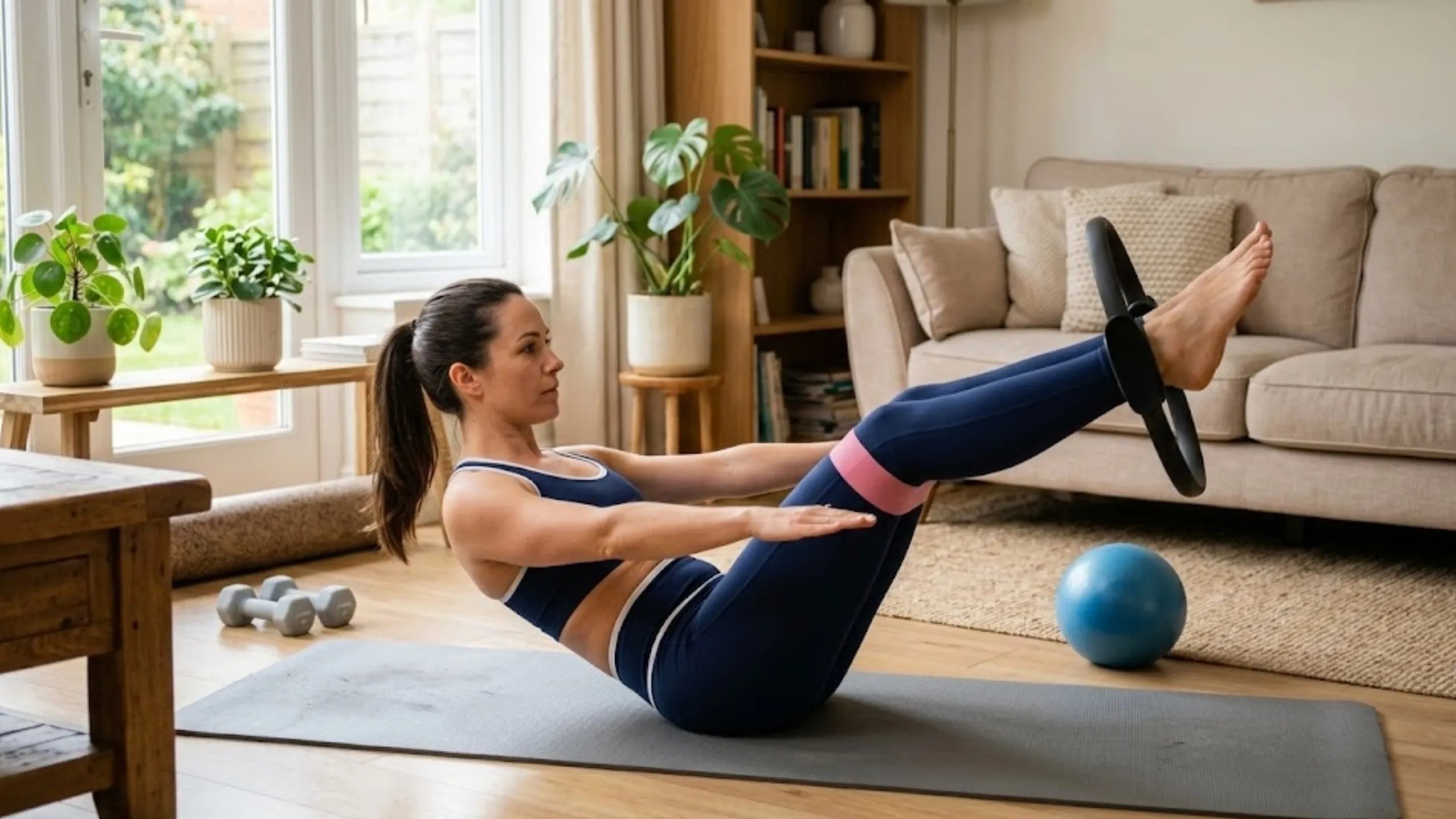
Foundational mat work is excellent for starting out. It provides valuable routines using exclusively your body weight for basal motor control.
However, the common mistake I see is stopping right there. The pursuit of more complex strength stimuli inevitably requires making the leap to mechanical equipment.

The spring system maintains constant elastic tension throughout the entire range of motion. This completely eliminates the dead spots of inertia where your muscles usually rest when lifting traditional weights.
Pilates exercises you can do at home: The Biomechanical Foundation
Before jumping on a heavy carriage, you must prove you can control your own mass. Foundational pilates exercises you can do at home are the ultimate test for your motor control.
Movements like the 'Hundred' or 'Roll-Up' on a mat expose your structural weaknesses immediately. They force your core to fire up without relying on momentum or external support.
Once you master these basal movements without shaking, your nervous system is biomechanically ready. Only then should you add the progressive resistance of a professional machine.
The Anatomy of the "Pilates Shake": Why You Tremble on the Carriage
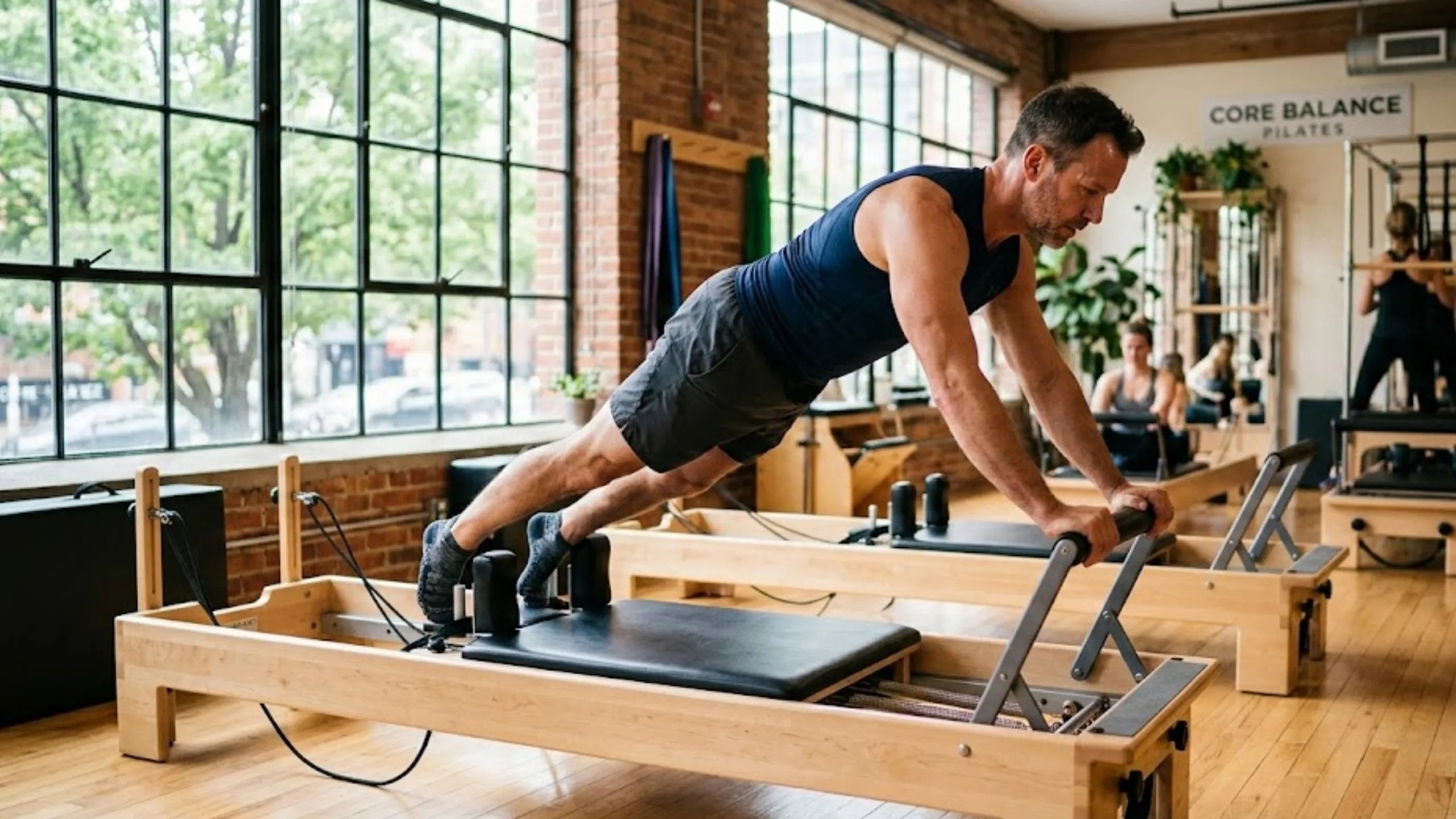
Athletes with high levels of hypertrophy are often surprised during their first interactions with the Reformer. It's highly likely that this machine will make you shake like a leaf in the first ten minutes.
The main reason is that your body, used to solid bases, doesn't know how to stabilize itself on a moving platform. Your nervous system detects the instability and fires up your deep stabilizer muscles.
This famous tremor doesn't mean you lack strength. It's simply the neurological compensation of your brain trying to find balance under dynamic stress.
Physics Against Men and Tall Users
Your body dimensions determine your mechanical advantage or disadvantage on the machine. Men, especially broader ones, carry almost all their weight in the chest and shoulder area.

When you get on moving equipment, all that upper mass makes you quite unstable. This requires immense corrective functional strength from your core to avoid losing balance.
Unlike women, who have a much lower center of gravity concentrated in the pelvis. They have a natural mechanical advantage in the initial movements thanks to that weight distribution.
Can you do reformer pilates at home? Sizing Your Hardware
A large anatomy relentlessly exposes the flaws of cheap hardware. If you are asking can you do reformer pilates at home, the answer relies strictly on the dimensions of the machine.
We list the models that actually fit a normal room on our page for Pilates reformers for home.
A 26-inch (67 cm) width is ideal so your broad shoulders aren't hanging off the edges while training. Also, you require a long travel distance of about 44 inches (113 cm) so you can stretch completely.
You absolutely need equipment that supports a dynamic weight limit of at least 330 lbs (150 kg) to be safe. Heavy commercial machines, which hover around 200 lbs (90 kg), are non-negotiable for big or tall men.
Look at the engineering of our springs and chassis in the Reformer catalog.
[Explore the collection here]
Live Tension vs. Dead Iron: The Law of Engineering
In traditional gym lifting, momentum and gravity give your muscles small pauses of relief. Your 220 lb bench press record will be absolutely useless on this platform.
On the Reformer, you operate under progressive elastic resistance (governed by Hooke's Law: $F=kx$). The method demands total control against a constantly varying resistance.

That extreme time under tension creates a perfect cellular stimulus for your fibers to grow strong. You manage to develop dense muscle without punishing your spine like heavy weights do.
Can you lose weight doing pilates at home? The Thermodynamics of Effort
Subjecting your fibers to continuous stress without rest requires extremely high energy availability. So, can you lose weight doing pilates at home? Yes, the physics demand it.
The stabilizing effort silently but deeply skyrockets your body's metabolic rate. Serious medical sources confirm the direct positive effects on overall flexibility and improved body composition.
Many older male users have reported real muscle mass gains by focusing on controlling the carriage return against the tension. You won't develop an inflated body, but the balanced physique of a gymnast.
Hardware Diagnostics: Toys or Clinical Tools?
To answer if having a Pilates setup at home is sensible, you must evaluate the equipment's static mass. Buying top-tier equipment should never be seen as just an unnecessary luxury.
The impact of a large body jumping will literally lift a cheap machine off the floor. It is an absolute requirement to invest in maintaining your structural integrity and avoiding injuries.
If space is the problem, Pilates chairs deliver real resistance in the footprint of an armchair. Beyond the reformer, the rest of the Pilates equipment for home and studio follows the same rule: mass and stability first. Your spine doesn't care about your budget, so you must choose based on technical data.
| Equipment Category | Static Weight | Chassis Material | Biomechanical Diagnosis & Stability |
|---|---|---|---|
| Entry / Foldable | 65 - 95 lbs | Hollow tube / Plastic | Unstable for adults; the frame yields to torsion and the equipment does not absorb kinetic force. |
| Advanced Home | 115 - 140 lbs | Maple & Steel | Good anchoring for medium-weight users. Improves stability but may fall short for heights over 6'1". |
| Clinical Commercial | 150 - 200+ lbs | Solid Maple / Extruded Aluminum | Absolute dissipator. Supports over 330 lbs dynamically and absorbs force without compromising spinal alignment. |
Frequently Asked Questions
Is it safe to install a heavy professional Reformer at home?
Yes. In fact, commercial-grade machines anchor securely to the floor and feel totally solid. Their high static mass acts as a dissipator, ensuring the chassis withstands the force of your movements.
Can I achieve the same physical result with just mat routines?
No. While the mat is key for motor control, the Reformer's spring system eliminates the resting points of free weights. This subjects your muscles to continuous effort, the perfect stimulus for dense muscle.
Why is it so difficult for men at first?
Men usually have more muscle mass in the upper body, making them unstable on the machine's moving carriage. Additionally, this exercise forces you to use deep stabilizer muscles that you normally don't activate.
What clothes should I wear to train safely on my home Reformer?
Ideally, use tight-fitting clothing, as loose garments risk getting caught in the machine's rails or springs. Additionally, wearing socks with non-slip grip is mandatory to avoid accidents.
Explore the reformers
We are an authorized dealer shipping new equipment from Miami, with free US shipping and financing.