Can you do reformer Pilates while pregnant? A guide to avoiding harm to your baby
If you browse forums, the dominant emotion is always a mix of eagerness, uncertainty, and the eternal doubt of who to listen to. It is completely normal to feel that confusion. The Reformer is not like a traditional dumbbell resting on a firm floor.
It is a mobile, dynamic base that demands constant core stability in every single movement. That is why many students experience the famous "Pilates shake" in their legs. It is not weakness; it is simply your nervous system waking up those small stabilizing muscles.
By having to control the carriage return, those deep muscles work extra hard so you don't lose your center. And with pregnancy, that fragile bodily balance shifts every single day. As your center of gravity moves forward because of the belly, the machine will force you to adjust your posture. If you are wondering if you can keep training, the absolute key is body control, not brute force.
Is it safe to do Pilates while pregnant? Listening to your changing body
To answer if it is safe, we first need to talk about the big flexibility trap. Your body releases relaxin, a hormone with the very specific purpose of opening up your pelvis. This loosens absolutely all your ligaments, making you feel like you have the flexibility of a gymnast.
But overstretching those vulnerable joints can cause silent tears and injuries. The practical studio advice is to move only as far as you feel strict muscular control. If you think you can open your legs to the absolute limit, the answer is no. Stop your range of motion much earlier.
Plus, your belly will start pulling your body forward, causing that sharp lower back pain. This is where the Reformer becomes your best and most noble ally. By strengthening your glutes and posterior chain with the straps, your back acts as a natural counterweight.
This restores a pain-free posture and relieves lower back tension in a real, deep way. Finally, say goodbye to classic crunches so you don't cause the dreaded diastasis. Instead, you will train your deep abdomen by hugging the baby inward, creating an internal protective corset.
Can you do hot Pilates while pregnant first trimester? Why you need to avoid the heat
If you ever searched if you can do Hot Pilates in your first trimester, the practical answer is a resounding no. The explanation is very simple: during these months, you are the only cooling system your baby has. If you overheat in a room at nearly 104ºF, your baby suffers that extreme heat too.
That extra heat makes your blood rush to your skin in a desperate attempt to cool you down. This causes blood pressure drops, suffocating dizziness, and robs your brain of vital blood and oxygen. The reality is that the true challenge at the start of pregnancy is not the belly, it is the crushing fatigue.
You will feel like you run out of air fast during exercises that used to be a simple warm-up. That is why in the studio we always apply the conversation test. If you cannot speak normally while training, you are going too hard. Shift into a lower gear without guilt.
Can I still do Pilates while pregnant? How to safely adapt as your belly grows
As the weeks go by, it is very normal to doubt when your usual postures start feeling strange. This is exactly where smart adjustments come in. In the second trimester, what we call the "stepped-on hose syndrome" appears.
From week 16 onwards, lying flat on your back will make the weight of your uterus crush a major vein. It is exactly like stepping on a garden hose: the blood flow returning to your heart gets cut off. This will make you feel dizzy or break out in a cold sweat. So, the flat posture simply gets modified.

The star solution is using a firm foam wedge that comfortably elevates your torso. By resting at an angle, like in a beach chair, gravity pulls the weight away and your blood flows freely. Starting to feel uncomfortable flat on your back? A good wedge is the best lifesaver for your prenatal classes.
Heading into the third trimester, you will notice your true limitations are pure mechanical logistics. Getting on, getting off, kneeling, and turning around on the carriage with a large belly simply requires too much energy.
How long can I do Pilates while pregnant? Choosing safe equipment for your home
It is one of the most classic questions we get in the studio. The reality is that many students practice until the day before giving birth if their body allows it. That focused training creates an invaluable neuromuscular connection for the moment of labor.
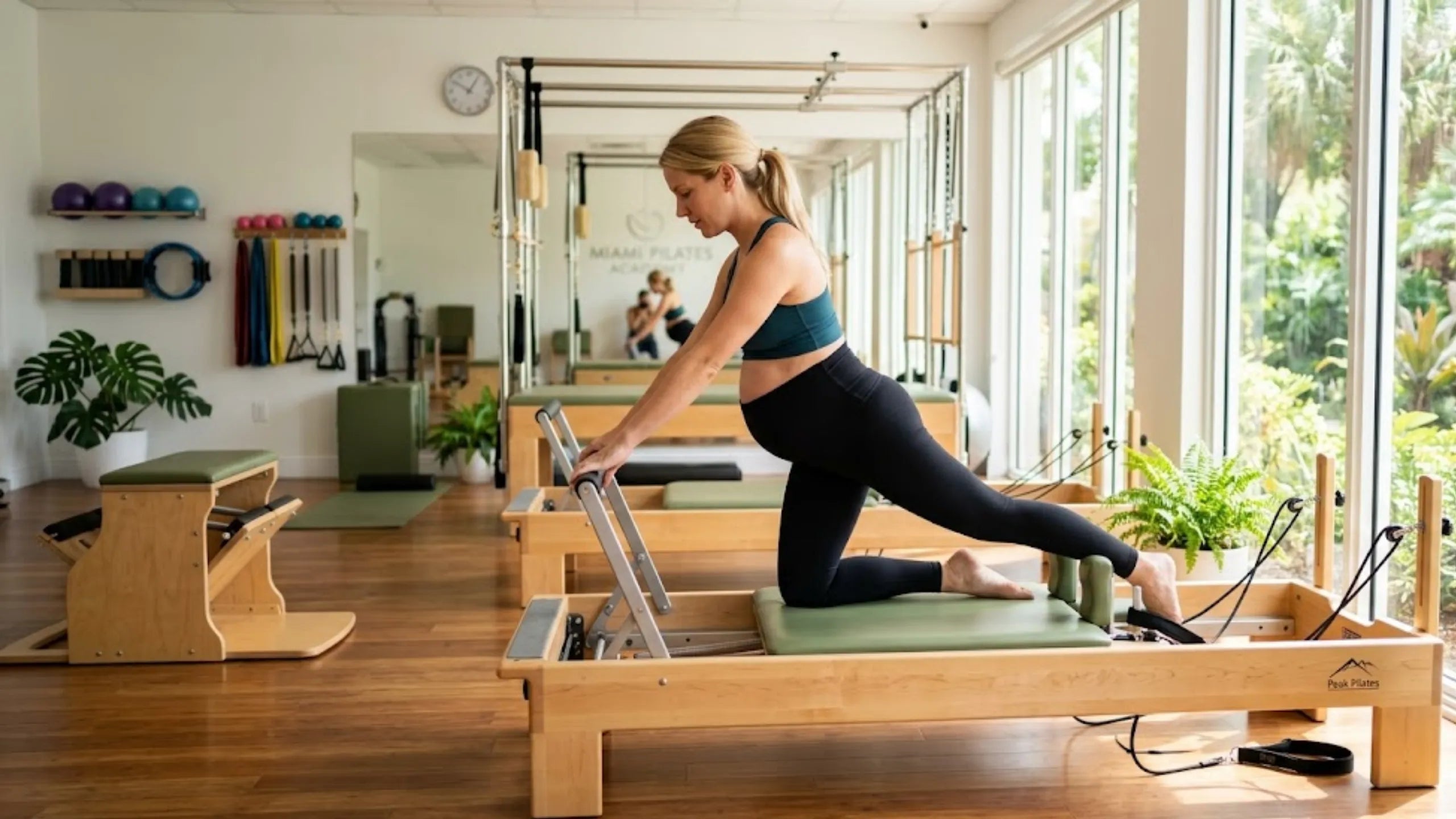
Learning to voluntarily contract and relax the pelvic floor on the Reformer makes the pushing stage much easier. But if you decide to train at home during these months, your equipment must be flawless and safe. For gentle extension and hip work as the belly grows, many students add spine correctors, which support the spine instead of asking it to fold. A cheap, lightweight machine that hops or squeaks when you move is a real physical danger.
With your compromised center of gravity, you need a heavy frame that absorbs the inertia of the exercise. It must stay anchored to the floor like cement. And pay close attention to the progressive spring resistance. Commercial steel springs give you mathematical, predictable tension.
They give you that deep sensation of smoothly "pushing mud" safely. Cheap bungee cords, on the other hand, deliver aggressive snap-backs when returning the carriage. That uncontrollable yank hurts your joints, which are already softened by the relaxin hormone.
You need the constant, firm support that only a metal spring can give you under your feet. Finally, make sure you have a wide carriage for side-lying postures, and a forgiving height. Getting in and out of the equipment with an eight-month belly shouldn't feel like an Olympic punishment.
To give you a clear idea: if you are going to train at home, prioritize steel springs and comfort.
Frequently Asked Questions
When should I tell my Pilates instructor I'm pregnant?
Ideally, tell them right away, even during your first trimester. You might not have a bump yet, but your body is already dealing with crushing fatigue. Your instructor needs to know to help you pace yourself and apply the conversation test.
What are the main reformer pilates pregnancy modifications I need to know?
The biggest shift happens around week 16, when lying flat on your back is off the table. In the studio, we use a firm foam wedge to keep your torso comfortably elevated. You will also avoid overstretching completely, as your joints are highly vulnerable right now.
Can I still do ab exercises on the reformer while pregnant?
Yes, but we completely change the strategy to protect your abdominal wall. Say goodbye to traditional crunches or heavy planks that push your belly outward. We focus on your transverse abdominis, training it as an internal corset that supports your baby.
Why do my legs shake so much during prenatal Pilates?
That uncontrollable trembling is universally known in the studio as the famous "Pilates shake." It happens because the moving carriage forces your nervous system to use tiny muscles so you don't fall. It is completely normal and just means your body is working hard to find its new balance.
When should you stop doing Pilates when pregnant?
There is no strict expiration date; many women practice until the day before they give birth. In reality, your stopping point is usually dictated by pure mechanical logistics in your third trimester. When simply getting on and off the low carriage becomes too exhausting, it might be time to rest.
Is a cheap home reformer safe for pregnancy workouts?
Honestly, it is a physical risk when your center of gravity is already compromised. Lightweight machines under 100 lbs tend to slide, hop, or squeak. You need a heavy, commercial frame that anchors to the floor and uses real steel springs, not elastics.
If you are setting up a safe practice at home, browse our Pilates reformers and home reformers.