What Can Pilates Do for Your Body? The Honest Truth (Science Backed)
Let's be realistic for a second. You're probably here because you've seen the "perfect Pilates body" that so many people would love to have. A slim, toned, effortless body, usually with a matching outfit that costs more than your weekly grocery bill. You've been sold the idea that if you take a few deep breaths and move your legs for 45 minutes, you'll magically wake up looking like a supermodel.
I’m here to burst that bubble. Not because Pilates isn’t effective—it is, in fact, it’s one of the most effective training methods on the planet—but because the marketing around it is full of lies.
Pilates is not a magic eraser for a bad diet. It’s not a "gentle stretching" class where you nap. If you do it right, it’s a grueling test of endurance that will make your muscles shake until they fail. If you’re looking for the truth about what this method can actually do for your anatomy (without the fluff), you’re in the right place.
How Well Does Pilates Work? Setting Realistic Expectations
There is a famous quote by Joseph Pilates that every studio plasters on their wall: "In 10 sessions you'll feel the difference, in 20 you'll see the difference, and in 30 you'll have a whole new body."
Is it catchy? Yes. Is it scientifically accurate? mostly anecdotal.
The problem with this quote is that it sets you up for failure if you don't define what a "session" looks like. If you go once a week and spend the rest of your time sitting hunched over a laptop eating takeout, 30 sessions (which would take you nearly 8 months at that rate) won't give you a new body. It will give you a slightly more flexible old body.
Pilates works by fixing your structural foundation. It’s engineering for humans. But like any construction project, if you don't show up to the job site, the house doesn't get built.
The Timeline: When will you see physical results?
Let's cut through the noise. Here is the realistic timeline for an average person doing Pilates 3 times a week:
-
Weeks 1-4 (The "What is happening?" Phase): You won’t look different. You might actually feel "thicker" because your muscles are retaining water from the inflammation caused by new stimuli. However, you will feel different. Your pants might fit the same, but you’ll stop groaning when you get out of a chair.
-
Months 2-3 (The Strength Phase): This is where the magic starts. You aren't necessarily dropping pounds on the scale, but your waistline tightens. Why? Because you are finally using your transverse abdominis (we'll get to that). Posture improves, making you look taller and more confident.
-
Months 6+ (The Transformation): If you’ve been consistent, this is where people start asking what you’re doing. The visual changes—muscle definition in the arms, the "lifting" of the glutes—become undeniable.
Why does Pilates work so well for core stability?
Most people think "core" means "six-pack." That’s wrong. Your six-pack (rectus abdominis) is a vanity muscle. It bends you forward, but it doesn't support your spine.
Pilates targets the Transverse Abdominis (TVA). Think of the TVA as the body’s internal corset. It wraps around your waist from back to front. When you do a crunch in the gym, you’re just flexing the surface. When you do Pilates, you are training the TVA to pull inward, tightening the entire circumference of your waist.
This is why powerlifters and football players do Pilates. It’s not for the aesthetic; it’s because a strong TVA creates a pressurized cylinder that protects the spine under load. The "flat stomach" is just a nice side effect of a stable spine.
Key Physical Benefits: Beyond "Long and Lean"
I need you to listen closely because this is where the industry lies to you. You cannot lengthen a muscle.
Your muscles are attached to your bones at fixed points (origin and insertion). Unless you break your bones and surgically separate them, your muscles will not get "longer." When an instructor tells you to "create long muscles," they are using a metaphor.
What they actually mean is eccentric strengthening. Pilates emphasizes lengthening the muscle while it is under tension. This prevents the bulky, shortened look that can come from partial-range weightlifting. You aren't growing longer muscles; you are improving your posture and resting muscle tension so that you appear longer.
Impact on Spinal Health and Posture
You live in a world designed to destroy your spine. You look down at your phone, you sit in a car, you hunch over a desk. This puts your spine in constant flexion, leading to what we call "Tech Neck" and rounded shoulders.
Pilates is the antidote. It forces your spine into extension (bending backward) and rotation. It hydrates the vertebral discs by moving them in every plane they were designed to move in.
If you have chronic lower back pain, it’s usually because your glutes are weak and your hip flexors are tight. Pilates fixes the muscle imbalances that cause the pain. It’s not a massage; it’s corrective mechanics.
Functional Strength vs. Hypertrophy
"Will I get bulky?"
No. But not because Pilates is "gentle." You won't get bulky because Pilates generally doesn't provide enough load to trigger sarcoplasmic hypertrophy (the type of growth bodybuilders chase where muscle cells fill with fluid).
Instead, Pilates builds myofibrillar hypertrophy and muscular endurance. You are building denser, stronger muscle fibers that can work for long periods without fatigue. This is functional strength. It’s the difference between looking like a bodybuilder who gets winded walking up stairs, and a dancer who can hold a plank for five minutes without shaking.
Rehabilitation and Injury Prevention (The Wellness Factor)
There is a reason physical therapists (PTs) use Pilates. It’s the safest way to rehabilitate an injury because it removes impact.
Running puts about 2.5x your body weight of force into your joints with every step. Pilates is closed-chain (usually your hands or feet are fixed to a bar or carriage), which stabilizes the joint while working the muscle. It allows you to strengthen the muscles around an injury without aggravating the injury itself. It’s not "wellness" woo-woo; it’s joint preservation.
Pilates Variations: Reformer vs. Wall vs. Mat
Here is where people waste their money. Not all Pilates is created equal.
Why the Reformer is the Gold Standard for Resistance
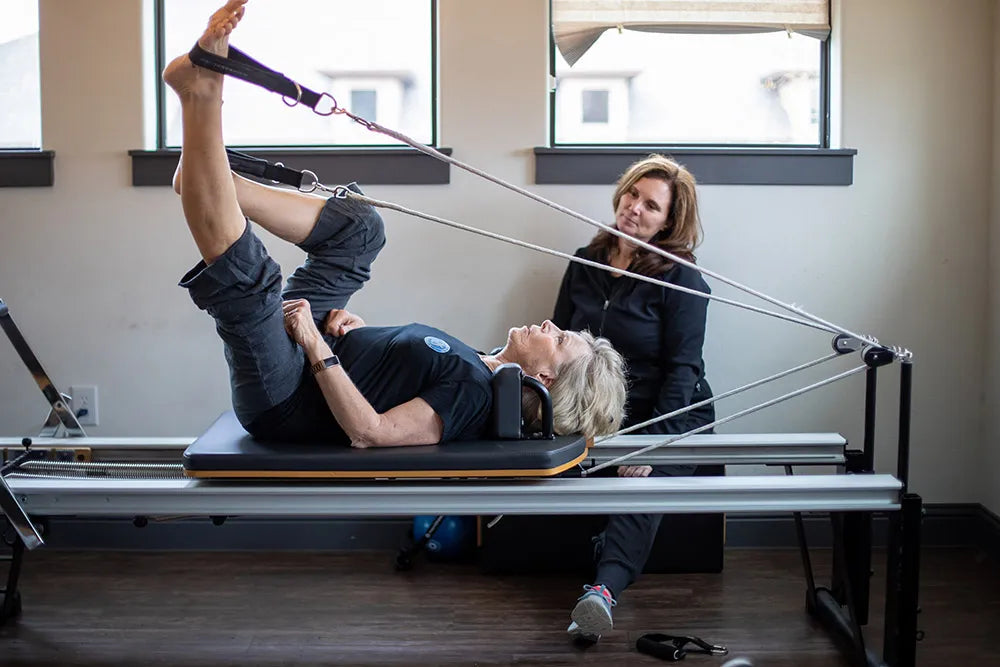
The Reformer looks like a medieval torture device, but it’s actually a brilliant piece of engineering. The magic is in the springs.
Weights (dumbbells) rely on gravity. Gravity only pulls down. Springs, however, provide variable resistance. The more you stretch a spring, the heavier it gets. And—this is the key—the spring wants to snap back. You have to fight the spring on the way out (concentric) and control it on the way back in (eccentric).
That control on the return is where the real strength is built. It creates "time under tension" that you simply cannot replicate with dumbbells or body weight.
How well does Wall Pilates work for home fitness?
I’m going to be brutally honest: Wall Pilates is a trend. It blew up on TikTok because it’s free and accessible, which is great. Anything that gets you moving is a net positive.
But is it as effective as a Reformer? Absolutely not.
Wall Pilates is mostly isometric training. You are pushing against an immovable object (the wall). You get the stability, but you lose the dynamic range of motion and the eccentric load of the springs. It’s a fantastic starting point or a travel solution, but don't expect Reformer results from pushing your feet against drywall. It’s the difference between riding a stationary bike and riding up a mountain.
The Mind-Body Connection: Neurological Benefits
Okay, put down the crystals. When we talk about the "Mind-Body connection" in Pilates, we aren't talking about your chakras. We are talking about your nervous system.
Pilates requires extreme focus. You have to think about your breath, your rib placement, your pelvic floor, and your shoulder stability all at the same time. You literally cannot think about your emails or your grocery list.
This forced focus downregulates your sympathetic nervous system (fight or flight) and activates the parasympathetic nervous system (rest and digest). It lowers cortisol. High cortisol makes you hold onto belly fat. So, in a roundabout way, the "mental" aspect of Pilates does help your physical results.
Maximizing Results: Choosing the Right Equipment for Your Goals
If you decide to do this at home, stop buying cheap garbage from Amazon.
-
The Mat: If you are doing mat Pilates, you need a thick mat (at least 10mm). A yoga mat is too thin; you will bruise your spine doing rolling exercises.
-
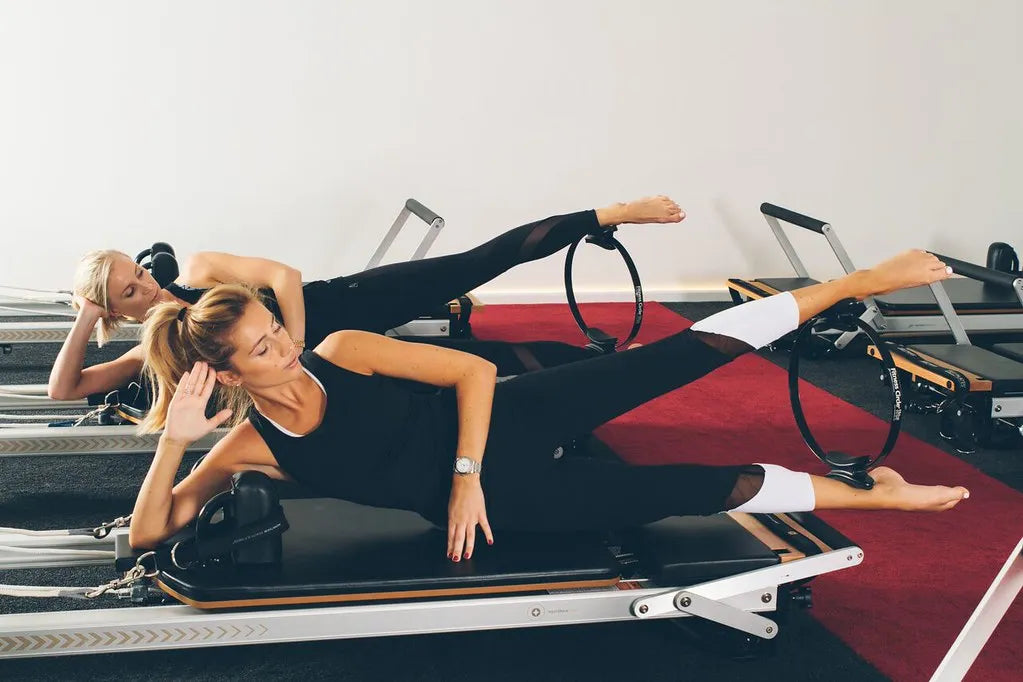
The Props: A "Magic Circle" (Pilates ring) is worth the investment. It adds resistance to adduction (squeezing in) which targets the inner thighs and chest, areas that are hard to hit with bodyweight alone.
-
The Reformer: If you buy a home Reformer for under $500, you are buying a toy. The springs will be inconsistent, and the carriage will drag. If you can't afford a quality machine, stick to Mat Pilates with props. Bad equipment causes bad form, and bad form causes injuries.
Frequently Asked Questions (FAQ)
Is Pilates enough to lose weight?
Here is the hard truth: No.
Pilates is not a high-calorie burner. An hour of Pilates might burn 200-300 calories. An hour of intense running or HIIT might burn 500-600.
If your only goal is to see the number on the scale go down rapidly, Pilates will disappoint you. However, Pilates changes your body composition. You might weigh the same, but you will look smaller and tighter. If you want to lose fat, you need a calorie deficit (eat less). Pilates shapes the muscle; the kitchen sheds the fat.
Can Pilates replace weightlifting?
It depends on your goals.
If you want to build significant muscle mass, increase maximum bone density, or compete in strength sports? No. You need to lift heavy iron.
However, for the general population who wants to be strong, pain-free, and look good naked? Yes, Pilates can be your primary form of resistance training, especially if you use the Reformer with heavy spring loads.
Ideally? Do both. Use Pilates to build the stability and core strength that allows you to lift heavier weights safely. They are best friends, not enemies.